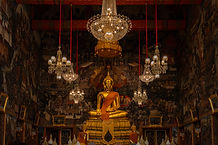
Must Do's Bangkok
Explore Bangkok, Thailand’s electric capital, through its river temples, old neighbourhoods, local markets and endless food scene. Visit Wat Pho and Wat Arun, take the public boat along the Chao Phraya River, eat your way through Chinatown and wander Talat Noi or Bang Rak when you need a break from the city’s bigger sights.
Bangkok can feel overwhelming at first, but give it time and its mix of history, street life and modern energy becomes impossible to leave behind.
One thing we can assure you: you’ll leave wanting more.

History of Bangkok
Founded as Thailand’s capital in 1782 by King Rama I, Bangkok grew from a small riverside settlement on the Chao Phraya River into the political, cultural and commercial heart of Siam. Shaped by royal palaces, Buddhist temples and international trade, it is now one of Southeast Asia’s most dynamic cities.

Over more than two centuries, Bangkok has been shaped by royal change, global trade, floods and rapid urban growth. It became the centre of the modern Thai state under the Chakri dynasty and has remained the country’s political and economic heart through every era of change.
Today, historic temples, riverside shophouses and old markets sit alongside skytrains, shopping districts and a constantly growing skyline. Bangkok’s past is not hidden behind museum walls. It is in the canals, food stalls, spirit houses and everyday rituals that still shape the city.
If you want to understand Bangkok and its history more deeply, start in Rattanakosin, the Old City. Walk around the Grand Palace and Wat Pho, take a boat across the Chao Phraya River to Wat Arun, then explore the streets in between.
It is the clearest way to see how a small riverside capital became the city Bangkok is today.

Do NOT miss in Bangkok
Bangkok is a city that rewards curiosity, with some of its best experiences tucked between the temples, river and old trading districts. Begin in Rattanakosin, Bangkok’s historic Old City, where the Grand Palace, Wat Pho and Wat Arun tell the story of the former Siamese capital. Take the public boat along the Chao Phraya River instead of a tourist cruise, then visit Pak Khlong Talat, Bangkok’s flower market, after dark.

For a truer sense of Bangkok beyond the famous sights, spend a day walking Song Wat, Talat Noi and Chinatown. Old Chinese shophouses, small shrines, workshops and narrow alleys lead into Yaowarat, where Bangkok street food takes over in the evening. Visit Khlong Toei Market in the morning if you want to see a working local market rather than a curated version of one. Art lovers should add Bangkok Art and Culture Centre, while a weekend in Chatuchak is worth it for independent makers, vintage finds, plants and food.
When you need a break from the city, cross the river to explore Thonburi’s canals or take the short ferry to Bang Krachao for a slow bicycle ride through greenery. As night falls, Bangkok is at its best when you follow the rhythm of a neighbourhood rather than chase one famous place. Eat where the tables are full, take a river boat when you can and leave enough time for the city to surprise you.

Where to eat Bangkok
Bangkok’s dining scene is one of the most exciting in the world, ranging from legendary street food and local markets to Michelin starred restaurants and rooftop dining above the city skyline.
Start with the classics. Pad kra pao, boat noodles, som tam, mango sticky rice and of course Thai curries are everywhere, but some of the best experiences come from simply following the crowds at local markets and street stalls.
Yaowarat in Chinatown is one of Bangkok’s most famous areas for street food, while neighborhoods like Song Wat, Ari and Thonglor mix traditional Thai flavors with a growing café and restaurant scene.
For a more refined experience, Bangkok has an impressive fine dining culture, with restaurants combining traditional Thai ingredients and techniques with contemporary presentation. The city is also packed with international restaurants, from Japanese and Korean to Italian, Middle Eastern and modern European cuisine.
Coffee culture deserves its own mention ☕️ Bangkok is full of specialty coffee shops, hidden cafés and beautifully designed spaces. Talat Noi, Song Wat, Ari, Phrom Phong and Thonglor are some of our favorite areas for café hopping.
Whether you are eating noodles from a street stall for a few euros or watching Bangkok light up from a rooftop restaurant, food is one of the best ways to experience the city.
Tip: Do not plan every meal before arriving. Some of our favorite places in Bangkok were discovered simply by walking around a neighborhood and seeing where locals were eating.
More on the Bangkok restaurants, cafés and foods we think you should not miss coming soon...

Where to stay in Bangkok
Bangkok is huge and traffic can be unforgiving, so your neighbourhood matters more than choosing the most famous hotel. For a first trip, stay near the BTS, MRT or Chao Phraya River boats. It will give you far more time to explore and far less time sitting in a Grab.'
For the best balance of food, culture, transport and atmosphere, choose Bang Rak, Charoen Krung or Sathorn. You will be close to the river, historic neighbourhoods, great local restaurants and both BTS and MRT connections. The riverside is ideal if you want quiet mornings, beautiful hotel views and easy access to the Old City by boat, although it usually comes at a higher price.
Phrom Phong, Thong Lo and Ekkamai are good for modern hotels, restaurants, cafés and nightlife, but they are busier and often more expensive. For a more lived in feel and better value, stay around Phra Khanong or On Nut. Both are connected by BTS and give you a more local side of Sukhumvit without being far from central Bangkok.
The Old City and Banglamphu are best if temples, history and walking are your priority. They feel completely different from Sukhumvit, but transport is less convenient. Ari is another strong option for a quieter, more residential base with good cafés, food and easy BTS access.
Great areas to stay: Bang Rak, Charoen Krung, Sathorn, Riverside, Phrom Phong, Ekkamai, Phra Khanong, On Nut, Ari, Rattanakosin Old City and Banglamphu.
Two Bangkok stays we loved, but only one we’d choose for a first trip
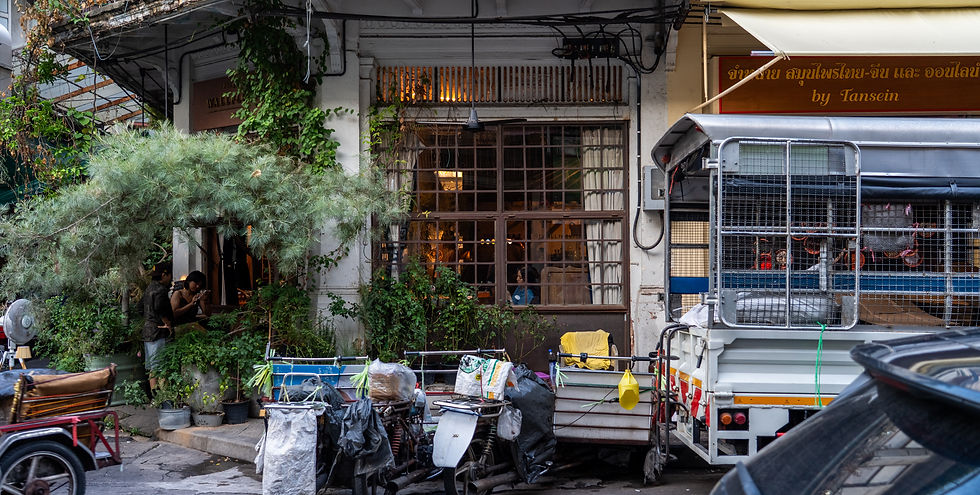
For a first trip to Bangkok, The Coffee Store Charoenkrung would be our pick. The biggest reason is the location. We could walk to Talat Noi, Chinatown and Song Wat, which were some of the areas we most wanted to explore. Being close to the Chao Phraya River also meant we could use the river boats to reach other parts of Bangkok without automatically relying on Grab and getting stuck in traffic.
The stay itself offered very good value for money. Breakfast was included, and we especially liked getting a proper Thai breakfast rather than the standard hotel breakfast experience. The air conditioning worked well, and we were offered water when we arrived.
The main downside was the traffic noise, which was clearly audible in the room. The hosts had provided earplugs, though, and with those it did not bother us too much.
For us, the location easily outweighed that drawback. If Chinatown, Talat Noi, Song Wat, local food and the older riverside side of Bangkok are high on your list, this is a very practical base.
The Coffee Store Charoenkrung is a small, locally owned café and homestay run by a Thai couple in one of Bangkok’s most interesting areas. The café sits downstairs, while the room is located above it, giving the stay a much more personal feel than a typical hotel. It is simple, local and very well placed for exploring Charoen Krung, Talat Noi, Song Wat and Chinatown on foot.
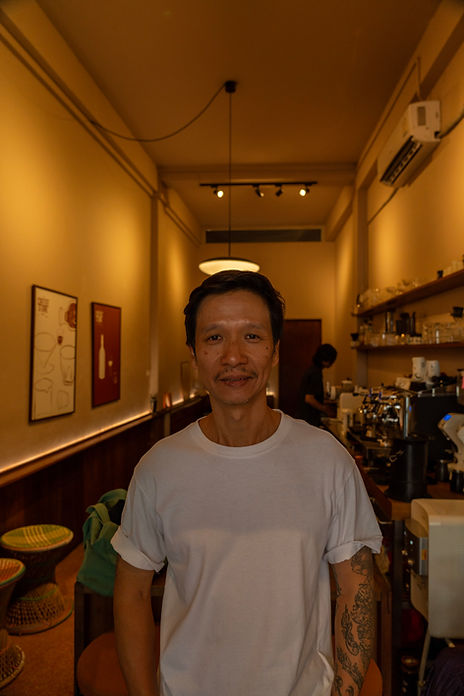
Danita’s Home
We absolutely loved Danita’s Home, but we would choose it for a different type of Bangkok trip.
The area had plenty of cafés nearby, a much more residential feel and one of our favourite restaurants from the entire trip. If we were staying in Bangkok for longer, working during the trip and wanted to build more of a daily routine, this is exactly the type of area we could see ourselves choosing again.
For our first visit, however, it was less convenient.
Many of the neighbourhoods and places we wanted to experience were in completely different parts of Bangkok, which meant we spent far more time than expected sitting in traffic. We also found that quite a few places around us closed relatively early, which made the area less useful for us in the evenings.
That does not make Danita’s Home a worse stay. In fact, we loved the accommodation itself. It simply suited a slower, longer Bangkok stay better than the sightseeing heavy first trip we were taking.
Which one would we choose?
For a first trip to Bangkok, we would choose The Coffee Store Charoenkrung because its location worked much better with the places we actually wanted to visit.
For a longer or return trip, when cafés, routine and experiencing a more residential side of Bangkok mattered more than being close to major first time sights, we would happily consider Danita’s Home again.
The biggest lesson for us was simple: choose the area based on your itinerary first, then choose the accommodation.

Must know Bangkok
Bangkok is Thailand’s capital and largest city, stretching along the Chao Phraya River rather than around one walkable centre. It is the country’s political, cultural and economic hub, but its character changes completely by area. Rattanakosin is home to the historic temples, Bang Rak and Chinatown are best for food and old city life, while Sukhumvit, Sathorn and Ari offer a more modern side of Bangkok.
The weather is hot and humid all year. November to February is usually the driest and most comfortable period, March to May is the hottest, and May to October brings regular rain. Thai is the official language. English is common in hotels, transport and tourist areas, but less so in local markets, so having Google Translate ready helps. The currency is Thai baht, and while cards are accepted in many places, cash is still essential for street food, small shops and markets.
For getting around Bangkok, use the BTS and MRT whenever possible, then Grab or a metered taxi for shorter journeys. The public boats on the Chao Phraya River are often the easiest way to reach the Old City without traffic. Keep normal city awareness, watch your belongings in crowded places and be cautious of anyone offering an unusually cheap tuk tuk ride or telling you a temple is closed.
At temples, cover your shoulders and knees, remove your shoes when asked and never point your feet towards Buddha images. Show respect around royal images and avoid public comments or jokes about the monarchy.
Bangkok is also a great base for day trips to Ayutthaya, Kanchanaburi and the quieter coastal towns around the Gulf of Thailand. The city can feel chaotic at first, but once you explore one area at a time, it quickly becomes one of the most rewarding places to visit in Thailand.

Local tips Bangkok
Bangkok is a city packed with food, culture and endless things to do, but experiencing it like a local makes all the difference. Skip the traffic whenever you can by using the BTS, MRT and public river boats, then use Grab for journeys that are not easily reached by train.
Money tip: For us, Revolut is the best travel card to use in Thailand. It makes it easy to pay in Thai baht without exchanging a large amount of cash at the airport. When paying or withdrawing money, always choose Thai baht and decline the ATM or card terminal conversion offer. Thai ATMs may still charge their own local withdrawal fee, so carry some cash for markets and street food. Get your Revolut card through our link here.
For a real taste of Bangkok, start early in a local market, eat at a busy noodle stall and spend time in the older neighbourhoods of Talat Noi, Song Wat and Chinatown. In the evening, Yaowarat comes alive with some of the city’s best street food, while the Chao Phraya River offers a calmer way to see Bangkok after dark.
Bangkok’s café culture is worth slowing down for too. Try Thai iced coffee, oliang or a traditional kopi in an old style coffee shop, then find a small neighbourhood café away from the malls. If you want to see the city at full energy, catch a Muay Thai fight, ride the BTS through the evening rush or simply sit at a busy local restaurant and watch Bangkok move around you.

3 Day Bangkok Itinerary: Food, Cafés & Neighbourhoods Beyond the Usual Tourist Route
Planning 3 days in Bangkok? This relaxed Bangkok itinerary combines incredible food, specialty cafés, local neighbourhoods, the Grand Palace, Wat Arun, Talat Noi and Chinatown without trying to see everything at once.
Day 1
Ekkamai, Nana & Bangkok's food scene
Best for: cafés, modern Bangkok, street food and a very food-heavy evening.
9:00 — Start with coffee in Ekkamai
Start your first morning at A KEEN HOUSE.
Hidden down Sukhumvit 40, this is much more our idea of a Bangkok morning than rushing straight to the first attraction.
Order coffee, have something to eat and actually sit down for a while.
This itinerary has plenty of food coming later.
There is no need to start speed-running cafés at 9am 😂
10:30 — Explore Ekkamai
Give yourself some time to walk around Ekkamai before heading further into Sukhumvit.
We wouldn't give you a list of eight compulsory stops here.
Part of travelling Bangkok well is allowing yourself to turn down a street simply because something looks interesting. Small restaurants, independent cafés, shops and everyday neighbourhood life are a huge part of why we like this side of Bangkok.
12:30 — Make your way towards Nana
Jump on the BTS and continue towards Nana. Tip on using the BTS: CASH IS KING.
And no, we're not sending you here to follow a traditional Bangkok sightseeing route.
What makes this part of Sukhumvit interesting is how quickly the atmosphere changes from one street to another. Just for you to know what Nana is; one of the busiest, craziest, never stopping, never sleeping places there is in Bangkok (and the world).
Walk around the streets surrounding Nana, grab lunch somewhere that catches your attention and don't be afraid to choose somewhere you haven't already seen on TikTok.
Some of our best meals in Bangkok have started with Rodolfo looking at a completely random restaurant and deciding that it tickled his intuition 😂
16:00 — Give yourself a break
This is deliberately empty.
Go back to your hotel. Get a massage. Sit somewhere with an iced coffee. Do absolutely nothing.
Bangkok travel tip: don't underestimate how tiring heat + walking + traffic can become. Building breaks into your Bangkok itinerary will normally make the evenings much more enjoyable. If you wanted to see the entire Bangkok in three days, we can assure you, this itinerary is not for you...
18:00 — Eat your way along Banthat Thong Road
Tonight's destination is Banthat Thong Road, the famous food street running alongside Chulalongkorn University. When we tell you you will be overwhelmed with the amount of restaurants here, we mean it...
It's particularly popular with students and has developed into a huge food and social hub filled with everything from long-standing local restaurants and street food to newer dessert and dining concepts.
TIP: Make sure you come with time as the line for restaurants builds up ridiculously fast and do not arrive before 4:00 PM as not much is open. Want to book a table? Wrong street.

Day 2
Grand Palace, Wat Arun & Bangkok's Big Buddha
Best for: Bangkok history, temples, the river and some of the sights that really ARE worth seeing.
We know. This is supposed to be a Bangkok itinerary beyond the usual tourist route and we're sending you to the Grand Palace. Avoiding somewhere just because it's famous doesn't make travelling more authentic. Some famous places are famous for a reason. The difference is that we're not going to cram six Bangkok temples into the same day.
8:30 — The Grand Palace
(Breakfast recommendation: Sarnies. If you can't make it, just have something around The Grand Palace as there are plenty of restaurants here)
Start early at The Grand Palace and Wat Phra Kaew.
The palace currently opens at 8:30am and official tickets for international visitors are 500 THB. The palace grounds remain open until 4:30pm, while ticket sales finish at 3:30pm.
Allow around 1.5–2 hours. Avoid being scammed by drivers outside the palace. If they are not officials, just ignore them as they will insistently try to make you book a tour with them ''meanwhile the palace opens''.
Please, we beg you to remember that this is a sacred site and there is a dress code. Sleeveless tops, short shorts, mini skirts and several other types of inappropriate clothing aren't permitted.
10:30 — Walk around Old Bangkok
Do not immediately order a Grab to your next pin.
Spend a little time walking around the old streets of Rattanakosin / Phra Nakhon.
Grab something cold. Look down the smaller streets.
Find lunch when you actually get hungry.
This is exactly why we've left space between the main attractions.
12:00 — Cross the river to Wat Arun
Next: Wat Arun, the Temple of Dawn.
Rather than driving around the river, make the journey part of the experience and cross by ferry.
Give yourself roughly an hour here instead of treating it as a ten-minute photo stop.
Here you will need to have your shoulders covered. If you didn't follow our advice, you will be offered a scarf and you may pay what you will, but to avoid it, just come covered.
Also consider that at this time, the sun is burning. Make sure you have enough water and go under the shade from time to time.
13:30 — Lunch on the Thonburi side
Stay across the river for lunch.
Again, our rule would be: one actual lunch stop, not three restaurants because they're all saved on Google Maps. Take your time.
You're already heading deeper into Thonburi afterwards.
15:00 — See Bangkok's huge Big Buddha
Your final major stop is Wat Paknam Phasi Charoen, home to the enormous seated Buddha that now towers above this part of Bangkok.
This is where many itineraries make a geographical mistake. Wat Paknam isn't beside Wat Arun.
You are travelling farther into Thonburi, so treat it as its own destination rather than another quick temple stop.
And once you've seen it? You're finished sightseeing for the day. Seriously, don't underestimate Bangkok's heat, distances and traffic.
Evening — Keep it open, but this is what we would do...
A rooftop in Nana + dinner in Chinatown's famous Yaorawat street.

Day 3
Bangkok skyline, Talat Noi & Chinatown
Best for: photography, specialty coffee, old Bangkok streets and one of the best evenings for food. This might be our favourite day.
9:00 — Coffee 55 floors above Bangkok
Quick bite outside your accommodation and straight to the cafe.
Start at % Arabica Bangkok Empire Tower.
This particular % Arabica sits high inside Empire Tower in Sathorn and is officially described by Empire as the world's highest % Arabica branch. It's currently open daily from 7am to 9pm.
You come for the coffee. But you are absolutely staying for the Bangkok skyline.
Take your time here rather than treating it like another coffee pin to collect.
TIP: If you can come earlier, better. You will be surprised by high quickly this place fills up and the chairs with a window view run out.
11:00 — Head to Talat Noi
From Sathorn, make your way towards Talat Noi.
And once you get there, stop looking at your map every thirty seconds. Seriously.
Talat Noi is one of the places where wandering is the activity. Old shophouses. Tiny alleys. Workshops. Street art. Cafés.
Cars somehow squeezed into spaces where cars definitely shouldn't fit. Photography opportunities everywhere. Don't miss the huge elephant painting on the wall.
TIP: It gets crowded, as it is one of the most popular streets in Bangkok. The viral mango sticky rice is average, but going to the shop is worth it for the picture.
15:00 — Slowly make your way towards Chinatown
Talat Noi and Chinatown work extremely well together because you don't need another huge cross-city journey.
Instead, gradually move towards Yaowarat and Chinatown. But before the evening food madness begins...
15:30 — Coffee and cake at Wallflowers
Stop at Wallflowers Café, Restaurant & Bar.
It's hidden inside an old shophouse surrounded by plants, vintage details and exactly the kind of slightly chaotic atmosphere we love finding in Bangkok.
Important: Wallflowers is on Soi Nana in Chinatown.
This is NOT Nana BTS / Sukhumvit.
Bangkok decided that having two completely different areas called Nana wouldn't be confusing enough.
17:00 onwards — Chinatown
Now forget the itinerary.
Seriously.
This is your Chinatown plan:
Walk.
When something smells good, stop.
Order something.
Share it.
Keep walking.
Find something else.
Then find dessert.
Yaowarat doesn't need to become a checklist.
The food is the itinerary.
And don't assume the longest TikTok queue automatically means the best meal.
Look at where people are eating.
Follow your intuition occasionally.
That's how we found one of the best soups we've ever eaten.